
Plant Room Ventilation Assessment Using CFD
Advanced CFD Simulation for Ventilation Effectiveness, Heat Management, and Equipment Reliability
Plant rooms often contain heat-generating equipment that requires effective ventilation to maintain safe operating temperatures and reliable operation.
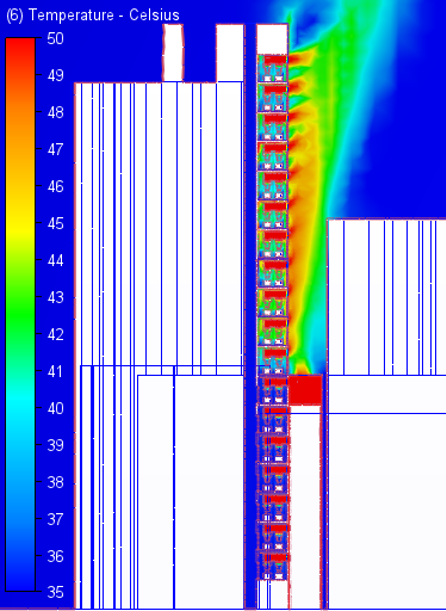
Deratec recently completed a Computational Fluid Dynamics (CFD) assessment for multiple plant rooms within a high-rise commercial development. The study evaluated airflow behaviour, ventilation effectiveness, and temperature distribution to verify the performance of the proposed natural ventilation strategy.
The Challenge
Plant rooms can experience significant heat build-up due to equipment operation and restricted airflow paths.
The key project objectives were to:
✔ Verify ventilation effectiveness within the plant rooms
✔ Assess airflow through louvre systems and ventilation openings
✔ Evaluate temperature distribution and heat accumulation
✔ Identify potential hot spots and air recirculation
✔ Support informed design decisions before construction
CFD Simulation Approach
A detailed three-dimensional CFD model was developed using Autodesk CFD to simulate airflow and temperature behaviour throughout the plant rooms.
The assessment included:
✔ Multiple plant rooms across the development
✔ HVAC outdoor equipment heat loads
✔ Louvre-based ventilation systems
✔ Building geometry and surrounding structures
✔ Various wind directions and calm conditions
✔ Summer design temperature conditions

The simulations provided detailed insight into airflow patterns, heat dissipation, and overall ventilation performance.
Key Findings
The CFD analysis demonstrated that the proposed ventilation strategy generally provided effective airflow and temperature control throughout the development.
The study also identified several upper-level plant rooms where partial recirculation of warm exhaust air could occur under certain operating and wind conditions, leading to elevated equipment inlet temperatures.

The simulations helped identify:
✔ Airflow circulation patterns
✔ Areas of heat accumulation
✔ Potential warm air recirculation
✔ Ventilation effectiveness under varying conditions
✔ Opportunities for design optimisation
Design Recommendations
Based on the CFD results, several practical recommendations were developed to further improve plant room performance.
These included:
✔ Enhancing ventilation capacity in critical areas
✔ Improving heat dissipation pathways
✔ Reducing warm air recirculation
✔ Optimising airflow distribution
✔ Verifying equipment performance under peak summer conditions
Implementing these measures can improve equipment reliability, reduce overheating risks, and support long-term operational performance.
Standards & Design Considerations
The assessment considered applicable ventilation and building performance requirements, including:
✔ NCC 2022 Performance Requirements
✔ AS 1668.2 – Mechanical Ventilation in Buildings
✔ AS 1668.4 – Natural Ventilation in Buildings
✔ Equipment manufacturer operating requirements
✔ Industry best-practice ventilation design principles
Why Use CFD for Plant Room Design?
CFD provides engineers and project teams with detailed insight into airflow and temperature behaviour before construction begins.
For plant rooms and equipment spaces, CFD can help:
✔ Reduce overheating risks
✔ Improve ventilation effectiveness
✔ Optimise equipment performance
✔ Support performance-based design solutions
✔ Minimise costly design changes later in the project
Applications
Deratec provides advanced CFD simulation services for:
• Plant rooms and HVAC equipment spaces
• Generator rooms
• Electrical and switch rooms
• Battery storage and inverter systems
• Substations and transformer enclosures
• Industrial ventilation and heat management
Conclusion
Advanced CFD simulation provides a powerful tool for assessing plant room ventilation performance and equipment heat management.
For this project, CFD identified potential warm-air recirculation within several plant rooms and provided practical recommendations to improve airflow, heat dissipation, and overall system performance before construction.
The assessment gave the project team greater confidence in the proposed ventilation strategy while reducing potential operational risks.
Need Assistance with Plant Room Ventilation?
Whether you are assessing a plant room, generator room, battery enclosure, substation, or industrial facility, Deratec can help optimise airflow, temperature control, and ventilation performance using advanced CFD simulation.


Comments